
Process Capability Analysis (Ppk / Cpk)
Overview
The process capability analysis evaluates whether a manufacturing process is capable of consistently producing products within the specified tolerance limits. In contrast to machine capability studies (MFU), which only consider short-term machine capability, process capability analysis takes into account all influences that occur over a longer production period.
my8data distinguishes between two groups of process capability indices:
| Index Pair | Designation | Time Horizon | Variation Basis |
|---|---|---|---|
| Cp / Cpk | Preliminary Process Capability | Short-term (within subgroups) | Variation within subgroups (R̄/d₂ or s̄/c₄) |
| Pp / Ppk | Process Performance | Long-term (entire dataset) | Overall variation (overall standard deviation) |
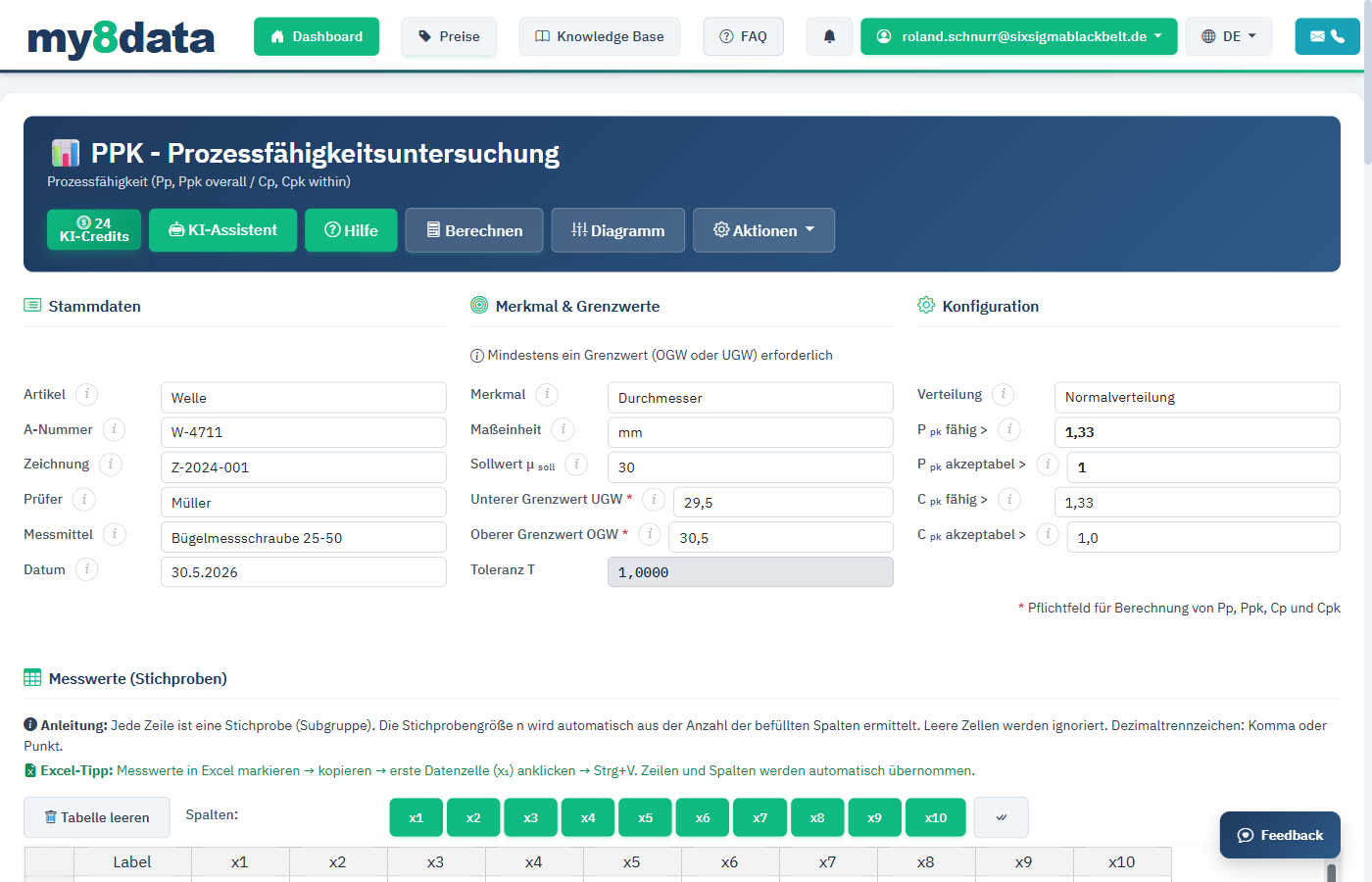
When to use which index?
- Cp/Cpk: Suitable for evaluating short-term process capability. These indices show the potential of the process when only inherent variation is considered.
- Pp/Ppk: Suitable for evaluating long-term process performance. These indices reflect actual process performance, including all influencing factors such as tool wear, material batches, temperature changes, etc.
Info: In an ideal, stable process, Cp and Pp should be close to each other. A significant difference between Cp and Pp indicates systematic influences that occur over time (e.g., drift, shift changes).
Typical Requirements
| Industry / Standard | Cp/Cpk Minimum Requirement | Pp/Ppk Minimum Requirement |
|---|---|---|
| General (VDA) | >= 1.33 | >= 1.33 |
| Automotive (IATF 16949) | >= 1.33 (series release) | >= 1.67 (first sample) |
| Safety-critical characteristics | >= 1.67 | >= 1.67 |
| Special processes | >= 2.00 | >= 2.00 |
Warning: The threshold values mentioned here are industry-standard guidelines. The specific requirements are determined by your customer's specifications or applicable standards.
Data Entry and Specifications
Data Structure
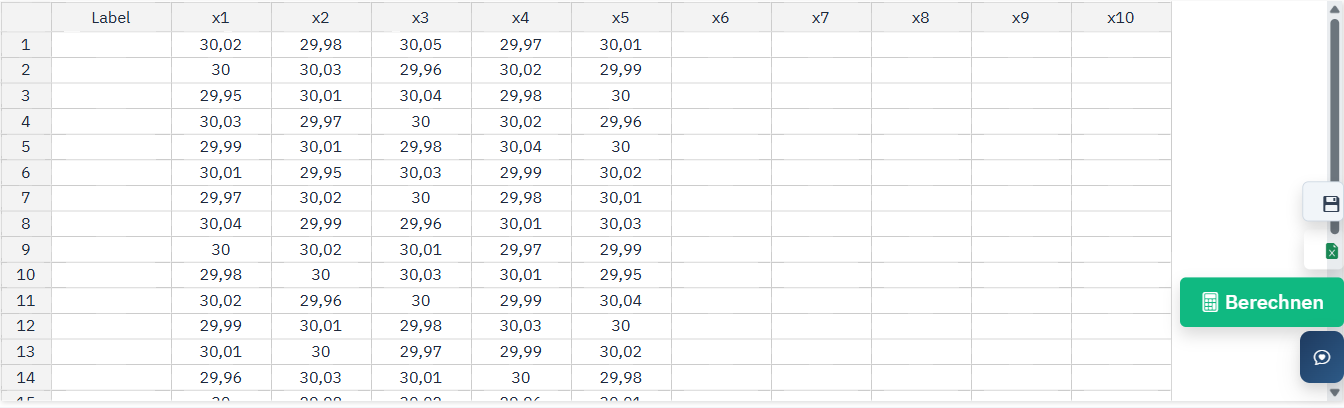
For process capability analysis, you need measurement data collected over a representative production period. The data should reflect typical process variations (different shifts, material batches, environmental conditions, etc.).
Recommended Data Quantities
| Analysis | Minimum Data Points | Recommended | Subgroup Formation |
|---|---|---|---|
| Cp/Cpk (preliminary) | 50 | >= 100 | 20-25 subgroups of 3-5 parts each |
| Pp/Ppk (long-term) | 100 | >= 125 | 25 subgroups of 5 parts each |
Specification Limits
Enter the specification limits as in the MFU:
- USL (Upper Specification Limit): The maximum permissible measurement value
- LSL (Lower Specification Limit): The minimum permissible measurement value
- Target (optional): The desired nominal value
Subgroup Formation
The formation of subgroups is critical for distinguishing between short-term and long-term variation:
- Within a subgroup: Parts manufactured under the same conditions (short time period, same tool, same operator)
- Between subgroups: Time intervals that capture typical process variations
Tip: A proven approach is to collect 5 consecutive parts per hour or per shift over a period of at least 20 production cycles. This ensures that both short-term and long-term variation are captured.
Input Formats
my8data supports data entry in the following formats:
| Format | Description |
|---|---|
| Manual entry | Direct input of measurement values into the table |
| CSV import | Comma- or semicolon-separated text file |
| Excel import | .xlsx or .xls file |
| Clipboard | Paste from clipboard (Copy & Paste) |
Indices Cp, Cpk, Pp, Ppk
Cp — Process Capability Index (short-term)
The Cp value describes the ratio of tolerance width to short-term process variation. It shows the potential of the process without considering the location of the mean.
Formula:
Cp = (USL - LSL) / (6 * σ_within)
The variation σ_within is estimated from the variation within subgroups (e.g., via R̄/d₂ or s̄/c₄).
Cpk — Critical Process Capability Index (short-term)
The Cpk value additionally considers the location of the process mean relative to the specification limits, in addition to Cp.
Formula:
Cpk = min((USL - x̄) / (3 * σ_within), (x̄ - LSL) / (3 * σ_within))
Pp — Process Performance Index (long-term)
The Pp value has the same structure as Cp but uses the overall standard deviation of all measurements instead of the variation within subgroups.
Formula:
Pp = (USL - LSL) / (6 * σ_overall)
Ppk — Critical Process Performance Index (long-term)
The Ppk value considers the location of the mean analogous to Cpk but is based on the overall standard deviation.
Formula:
Ppk = min((USL - x̄) / (3 * σ_overall), (x̄ - LSL) / (3 * σ_overall))
Relationship of Indices
| Comparison | Interpretation |
|---|---|
| Cp ≈ Pp and Cpk ≈ Ppk | Stable process; little difference between short- and long-term variation |
| Cp > Pp | Long-term variation is greater than short-term variation; systematic influences present |
| Cpk < Cp | Process mean is not centered; adjustment recommended |
| Cpk ≈ Cp | Process is well centered |
Info: The ratio of Pp/Ppk to Cp/Cpk provides insight into process stability. The quotient Cp/Pp is sometimes called the instability index. A value close to 1.0 indicates a stable process.
Assessment Table
| Index | Assessment | Recommended Action |
|---|---|---|
| >= 2.00 | Excellent | No measures required; process is excellent |
| 1.67 - 1.99 | Very good | Process meets high requirements |
| 1.33 - 1.66 | Capable | Process meets standard requirements |
| 1.00 - 1.32 | Marginally capable | Improvement measures recommended |
| < 1.00 | Not capable | Immediate action required; scrap likely |
Warning: A non-capable process (Cpk or Ppk < 1.00) means that process variation is greater than tolerance width. In this case, parts outside the specification will likely be produced. Immediate corrective action is necessary.
Control Charts
Purpose of Control Charts
Control charts are an essential component of process capability analysis. They serve to visualize the process over time and to identify whether the process is statistically controlled (in control).
Info: The calculation of Cp/Cpk assumes that the process is statistically controlled. If the control chart shows systematic patterns or rule violations, the calculated indices are not meaningful. Stabilize the process first before evaluating capability.
Available Control Charts
my8data automatically creates the following control charts as part of process capability analysis:
| Control Chart | Description | Application |
|---|---|---|
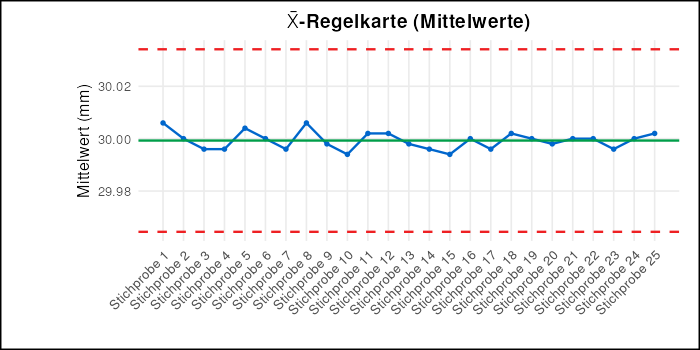
| x̄-chart (Mean chart) | Shows the means of subgroups over time | Detection of shifts in location |
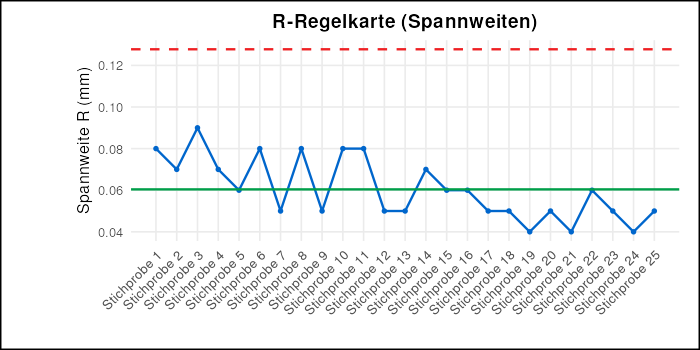
| R-chart (Range chart) | Shows the ranges of subgroups | Detection of variation changes (n <= 10) |
| s-chart (Standard deviation chart) | Shows the standard deviations of subgroups | Detection of variation changes (n > 10) |
Elements of the Control Chart
Each control chart contains the following lines:
- UCL (Upper Control Limit): Upper statistical limit at x̄ + 3σ
- CL (Center Line): Process mean
- LCL (Lower Control Limit): Lower statistical limit at x̄ - 3σ
Tip: Do not confuse control limits (UCL/LCL) with specification limits (USL/LSL). Control limits are calculated from the data and show the natural variation of the process. Specification limits are specified by the customer or drawing.
Interpretation
| Observation | Meaning |
|---|---|
| All points within UCL/LCL, no pattern | Process is statistically controlled |
| Points outside UCL/LCL | Special cause present |
| Trend (7+ ascending/descending points) | Systematic change (e.g., wear) |
| Run (7+ points on one side of CL) | Shift in process level |
| Stratification (Points close to CL) | Mixing of multiple populations |
Warning: Before interpreting process capability indices, always check the control charts first. A process that is not statistically controlled does not provide reliable Cp/Cpk or Pp/Ppk values.
Background: How Cp, Cpk, Pp and Ppk are defined and why the standards differ in their calculation is explained in Cp/Cpk process capability calculation on sixsigmablackbelt.de.